



Un texte de Daniel Sibony. Puis une réaction de Jacques Tarnero. Quelques lignes de Monette Vacquin. L’échange eut lieu entre amis, presque comme une conversation à bâtons rompus. Mais une question s’est peu à peu imposée : et si, derrière ce que l’on exige aujourd’hui d’Israël, se rejouait quelque chose qui le précède de très loin ? HaBayta a choisi de suivre le fil.
Il arrive qu’un texte poursuive sa route après avoir été écrit. Une réflexion de Daniel Sibony a circulé. Jacques Tarnero l’a lue et commentée. Puis Monette Vacquin, psychanalyste, a ajouté quelques lignes.
Quelques lignes seulement.
Mais de ce déplacement successif est née une question qui dépasse peut-être le texte qui l’avait provoquée.
Daniel Sibony part d’un malaise familier: il y a ceux qui aiment Israël, mais ne veulent plus avoir à le défendre. Ceux que tel gouvernement embarrasse, que tel ministre révulse, que telle décision éloigne. Ceux qui voudraient pouvoir soutenir Israël sans avoir à répondre de Netanyahou, de Ben Gvir, de Smotrich, des religieux, des colons, de Gaza, de tout ce qui vient immédiatement s’interposer entre eux et le simple fait de dire : oui, je défends Israël.
Sibony propose alors un déplacement: Ne défendez pas Israël, semble-t-il dire à ceux que le mot gêne. Regardez plutôt ceux qui veulent le détruire. Et demandez-vous ce que vous pensez d’eux.
La proposition paraît presque rhétorique. Elle ne l’est pas. Car elle oblige à séparer deux questions que le débat contemporain a fini par confondre : ce que fait Israël et le fait qu’Israël soit.
C’est exactement là que Jacques Tarnero intervient.
Sa formule tient en deux mots :
« Israël Est. »
Et il ajoute cette remarque essentielle : aimer Israël ne relève pas d’une « attitude esthétique ».
Le mot est remarquablement juste. Car quelque chose d’étrange s’est installé dans notre rapport à Israël : comme s’il fallait que le pays nous plaise pour que nous consentions pleinement à son existence.
On aime cet Israël-ci, pas celui-là. Celui des pionniers mais pas celui des religieux. Celui de Rabin mais pas celui de Netanyahou. Celui des kibboutzim mais pas celui des implantations. Celui des start-up, des écrivains, des chercheurs, des plages de Tel-Aviv — beaucoup moins celui de ses coalitions impossibles, de ses fanatiques, de ses fractures et de ses fautes.
Mais Israël n’est pas une préférence esthétique. Il n’est pas un tableau devant lequel nous déciderions si nous sommes encore émus. Il n’est pas davantage un idéal auquel un peuple réel aurait l’obligation de rester conforme pour conserver le droit d’exister.
Israël est un pays. Donc un pays imparfait. Avec ses gouvernants admirables ou médiocres, ses héros et ses démagogues, ses grandeurs et ses bassesses, ses conflits internes, ses erreurs, ses injustices, ses élections, ses manifestations et ses colères.
Tout cela peut être discuté. Tout cela doit pouvoir être combattu.
Mais tout cela vient après.
Après le fait premier :
Israël est.
Et puis Monette Vacquin intervient.
Elle déplace encore la question.
« Oui la haine précède de treize siècles l’existence d’Israël. Et survivrait à la destruction de celui-ci. »
Voilà peut-être le point le plus difficile à regarder.
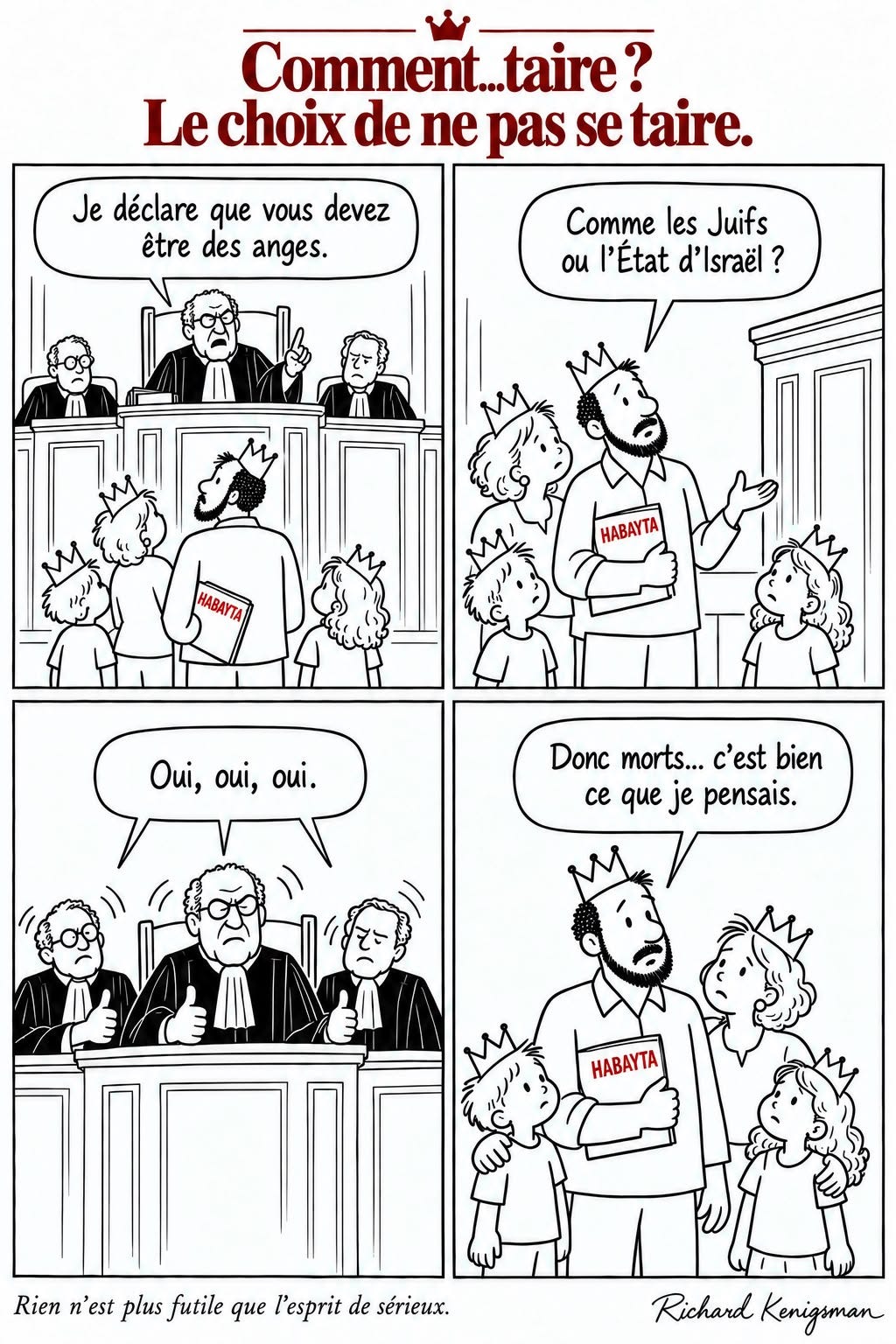
Et si, finalement, Israël n’était pas la véritable question ? Ou plutôt : s’il était aujourd’hui le lieu où vient se déposer une question beaucoup plus ancienne que lui ?
Israël est né en 1948. La haine des Juifs, évidemment, non. Elle a traversé les siècles, les religions, les continents, les régimes politiques. Elle a su modifier son vocabulaire, changer ses justifications, abandonner certaines accusations pour en inventer d’autres. Le Juif fut coupable d’être sans patrie. Le voici désormais coupable d’en avoir une.
On lui reprocha son cosmopolitisme. On lui reproche son nationalisme. Il était suspect parce qu’il vivait parmi les nations. Il devient suspect lorsqu’il constitue une nation.
Ce paradoxe devrait suffire à nous alerter. Car si l’accusation demeure lorsque son motif s’inverse, peut-être le motif n’était-il pas la cause.
C’est là que la remarque de Monette Vacquin devient vertigineuse : la disparition d’Israël ne mettrait pas nécessairement fin à la haine dont Israël est l’objet: elle pourrait simplement lui rendre son objet précédent. Le Juif.
Et soudain, la distinction proposée par Sibony prend une autre dimension.
Les ennemis d’Israël combattent-ils réellement une politique israélienne ?
Le Hamas n’a pas massacré le 7 octobre pour obtenir un changement de coalition à Jérusalem. Le régime iranien ne rêve pas de la disparition de l’État juif parce qu’il désapprouve une réforme judiciaire. Et lorsque « Palestine libre du fleuve à la mer » est scandé à Paris, Londres ou New York, la question posée n’est pas celle des frontières d’un futur accord diplomatique. Elle est celle de ce qui doit subsister entre ce fleuve et cette mer.
Cela n’interdit aucune critique d’Israël. Bien au contraire: refuser de critiquer Israël parce qu’il est menacé reviendrait encore à le soustraire à la condition politique ordinaire.
On peut combattre un gouvernement israélien. On peut manifester contre lui. On peut condamner une décision militaire, dénoncer une injustice, juger certains de ses ministres indignes de leur fonction.
Mais il faut retrouver la frontière intellectuelle que nous avons laissé s’effacer : celle qui sépare la critique de ce qu’un État fait de la contestation de ce qu’un État est.
Personne ne demande à la France de mériter chaque matin son existence. Personne ne suspend celle de l’Italie aux actes de son gouvernement. Israël, lui, semble condamné à repasser indéfiniment son examen de légitimité.
Et peut-être est-ce précisément parce que quelque chose d’autre se joue là. Quelque chose que la politique, seule, n’explique pas.
Monette Vacquin relève d’ailleurs que Daniel Sibony montre « combien la psychanalyse est indispensable à la compréhension du monde, politique ou pas ».
Il faudrait prendre cette remarque au sérieux. Car les haines collectives ne sont pas toujours raisonnables. Elles peuvent rationaliser après coup ce qui les précède. Elles changent d’argument sans nécessairement changer d’objet.
Alors, oui : discutons Israël. Disputons-nous sur Israël. Critiquons Israël lorsque nous le jugeons nécessaire. Mais cessons peut-être de confondre le procès d’une politique avec le procès d’une existence.
Daniel Sibony avait ouvert une porte. Jacques Tarnero l’a franchie en écrivant simplement : « Israël Est. » Monette Vaquin nous oblige à regarder ce qu’il pourrait y avoir derrière : la haine était là avant lui. Et peut-être serait-elle encore là après lui.
C’est précisément pourquoi la question d’Israël dépasse infiniment la question de savoir si Israël nous plaît.
ACT X - KAFKA AND THE MUFTI AL-HUSAYNI
The Island of the Absurd
From the heavens, silence is not peace; it is an expectation. Two men who never crossed paths on Earth observe the structure. On one side, Haj Amin al-Husayni, the former Mufti of Jerusalem, draped in his austere dignity. On the other, Franz Kafka, a slender silhouette, with the feverish gaze of one who spent his life drawing the contours of the inextricable.
AL-HUSAYNI (with a hard face, pointing at the building) It is a monstrosity. This is not a peace project. It is apartheid poured in cement. A colonial grid to wall us in alive inside our own home, under the watch of your lasers.
KAFKA (a melancholy, distant smile) A wall is physical bureaucracy, Mufti. It is the administration of separation. But what else did you expect from a court that has never finished its session?
AL-HUSAYNI In the beginning, we had nothing against you. When there were a thousand of you, coming to die piously in Jerusalem, you didn't bother anyone. You were our neighbors. But you came by the millions. You brought your laws, your machines, and now this giga-building. You do not share your home with a flood that wants to replace the foundations.
KAFKA (he raises an eyebrow, a cold gleam of irony in his eyes) Ah, the numbers... You have always had a weakness for large numbers and demographic flows, Amin. Especially between 1941 and 1945, around Berlin, isn't that right? Mass accounting was being done over there. They were planning the void with absolute Germanic rigor. You paid very close attention to it.
AL-HUSAYNI (stiffening) I was looking for allies to liberate my land, not moral lessons from a Prague writer. The problem is the land you took from us!
KAFKA (he nods gently, adjusting his collar) The land... Let us open another file, if you will. One of those absurd theses for which I have the secret. Imagine that at the end of the Second World War, our people, exhausted by Europe and financially aided by its global diaspora, had decided to make a radical choice. To avoid bothering anyone, to avoid removing a single olive tree, we legally buy a huge piece of ocean from the international community. Thousands of square kilometers of saltwater, in the middle of nowhere.
AL-HUSAYNI (frowning) Water?
KAFKA Water. And there, thanks to our money and our engineers, we build an artificial island. Gigantic. To the exact size and precise perimeter of present-day Israel. A masterpiece of civil engineering floating or anchored over the abyss. We call it Bis-rael. Our nation on a concrete raft, without a past, without direct neighbors, surrounded by waves as far as the eye can see. (Kafka steps closer to the Mufti, his gaze becoming piercing) Ask yourself the question, Amin. If we were over there, on Bis-rael, in the middle of the oceanic void... would you, and the rest of the world with you, continue to attack us? Would you still find a reason to charter ships to go and sink our island?
AL-HUSAYNI (A long silence settles in. The Mufti opens his mouth to answer with a political obviousness—that no, of course, the problem is Palestine—but the words get stuck in his throat. Kafka's metaphysical trap snaps shut. He looks at the blueprints of the Wall, then at the void of the heavens, searching for an answer in the folds of his memory and his hatred, but his lips remain closed. He does not know what to answer.)
KAFKA (with a weary sigh) You do not know. Because deep down inside, you sense the truth. Humanity would have invented long-range missiles to reach our raft. Our island would have been accused of diverting ocean currents or profaning the eternity of the sea. The Bureaucracy of rejection does not need a land registry to function. (he places his hand on the blueprint of the Wall) If the hatred of our existence is a universal decree that pursues us even in the middle of nowhere, then geography is merely a pretext. Fleeing to a fictional island would solve nothing. And if the world is to judge us guilty of existing anyway, then the only possible land, the only one that legitimizes our pain, is this one. Israel. The original castle.
And in my absurd thesis, did I mention even once that we could not share this land with you, my dear Mufti?
AL-HUSAYNI It is Kafkaesque.
From the heavens, the Mufti turns his gaze away, prisoner of a doubt he will never admit to himself. Kafka, on the other hand, looks at the Wall as one looks at one of his own short stories: an absurd, terrifying structure, but one that has become the only logical way out for those who have nowhere else to go.
The door exists. It is open. On one side, life. On the other, death. Between the two—you. Alone. As the Just have always been alone.
#THEWALLOFTHEJUST #AREWESTRONGENOUGH