

What happens when an Israeli chef takes his sense of humour from the kitchen to the comedy stage — and discovers that being Israeli is sometimes enough to make an audience stop laughing?
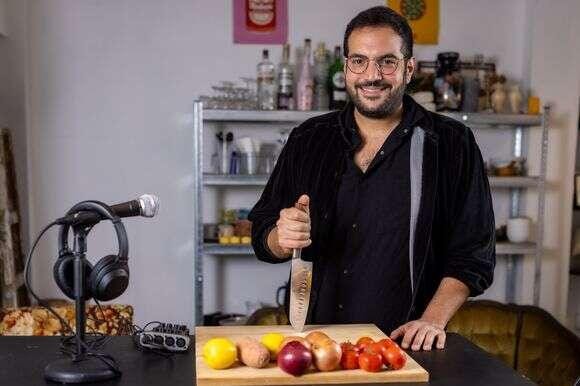
Meet Kobi Balulu, a stand-up comedian and professionally trained chef who has turned his two passions into an extraordinary combination. From Tel Aviv to London and Berlin, he explores the absurdities of identity, politics, cultural misunderstandings and everyday life.
Since October 7, however, comedy has taken on a different meaning. In Israel, making people laugh has become something close to a mission. Abroad, an Israeli comedian may find himself judged before he has even delivered his first joke.
In the first instalment of Lomir Lachen — Let’s Laugh!, a new HaBayta interview series celebrating Jewish comedians around the world, writer Daniella Pinkstein meets an artist whose wit, candour and self-deprecating humour reveal both the difficulties and the extraordinary vitality of Israeli comedy.
Interview with Kobi Balulu
Daniella Pinkstein:
Dear Kobi Balulu,
You are a true phenomenon in the world of Israeli stand-up, not only because of your shows, but above all because you combine the roles of chef and comedian. From the perspective of Paris, Moscow, or Honolulu, these are not obvious parallel activities!
You studied culinary arts in London, and I suppose your sense of humour was sharpened through your many travels, and certainly also by the Israeli atmosphere, where laughter serves as a response to hatred and despair.
Kobi Balulu:
I grew up in Givat Hamoreh, a neighbourhood in Afula, a city in Israel’s northern periphery, right in the heart of the beautiful, green Jezreel Valley. I grew up far from Tel Aviv, surrounded by nature.
Today, I split my time between comedy clubs and kitchens. I even created my own experience, Funny Fine Dine, which brings together my two biggest passions — cooking and stand-up comedy — in one evening.
Daniella Pinkstein: Before moving on to serious and weighty questions (or almost), can you tell me whether, in your opinion, there is a link between humour and cooking? Does one influence the other when creating a dish or a sketch? And does this link have something deeply Jewish about it?
Kobi Balulu:
Cooking and stand-up comedy are two very different jobs, but I think they have quite a lot in common when it comes to creativity: timing, surprise, and knowing how to keep people interested.
And in both jobs, you’re judged almost immediately. Whether you’re serving a dish or telling a joke, you can usually tell pretty quickly if people like what you’ve made.
Both a new dish and a new joke can take something familiar and give it a twist nobody saw coming. And in both cases, the result doesn’t always go down well, and sometimes it can be hard to digest!
Being a chef gives me an advantage when it comes to writing jokes about food and the culinary world, simply because it’s something I’ve spent years studying and working in. But plenty of comedians have other jobs or backgrounds they know inside out, and they can draw on those experiences in exactly the same way.
As for the Jewish connection, that’s an interesting question. In Israel, being Jewish is just part of everyday life. After all, it’s the Jewish state, so it’s not something that makes you particularly different.
I see myself more as a secular Israeli who grew up with Moroccan traditions. Food and hospitality were a big part of how I grew up. It’s a warm, family-oriented, generous culture, and to me, it’s also a big part of being Israeli.
Outside Israel, though, it’s a different story. Being Israeli and Jewish becomes a much bigger part of how people see me, especially when I’m performing.
And I’m just brown enough to get the best of both worlds: antisemitism and Islamophobia. Lucky me.
Daniella Pinkstein: You embarked on stand-up at a time of great instability for Israel, and for all Jews more generally. Has this changed the way you think about humour? And if so — or not — why?
Kobi Balulu:
When has Israel ever been stable?
I started doing stand-up when I was 15. For three years, I travelled two hours each way from Afula to Tel Aviv just to do a five-minute spot at an open mic. I’d get home around 2:30 in the morning and still have to get up for school.
When I joined the army, I was part of a military entertainment troupe as a stand-up comedian. Afterwards, I thought my stand-up days were over.
I spent the next few years travelling and living abroad, until I moved to London to study culinary arts. That’s where I decided to give stand-up another shot, this time in English.
That was in 2016, back when Israel had pretty good PR. Startup Nation, high-tech, liberal society, veganism, gays, you name it. And I was telling jokes about Israeli-Palestinian relations and Israel’s relationship with the rest of the world.
I haven’t stopped performing since.
Since October 7th, the war has changed the relationship between Israeli comedians and their audiences, both in Israel and abroad.
In Israel, I feel like comedy, not just stand-up, has started to mean a lot more. Making people laugh became our mission.
I’ve always thought stand-up was one of the most narcissistic jobs in the world. You get on stage, talk about yourself, and expect a room full of strangers to listen and laugh.
But when you’re performing for people who’ve been through so much, making them laugh, even for an hour, feels like a gift from God.
Suddenly, it’s not really about you anymore. Somehow, one of the most narcissistic jobs in the world started to feel almost selfless.
Being an Israeli stand-up comedian isn’t easy these days.
In Israel, if you make jokes about the government or criticize the country, people might call you a leftist or even a traitor.
But abroad, you’re Israeli, and that’s enough for some people to see you as a fascist.
So I’m a leftist in Israel and a fascist in Europe. Same joke, different culture.
A month ago, I performed in Berlin. The host introduced me, mentioned I was from Israel, and I walked on stage to no applause.
It was a tough gig from start to finish, probably because of where I came from.
That reaction might come, especially among younger, progressive audiences in Europe, from the way they see Israel.
I grew up on American and British comedy, and I consume a lot of Western culture. But I’m also Moroccan, born and raised in the Middle East. So naturally, my perspective is a little different.
In their eyes, Israel is the villain.
And I get it. I’ve done the same thing with conflicts around the world: picked a side almost immediately, without really knowing enough about what was going on, simply because I felt my heart was in the right place.
Daniella Pinkstein: What situations do you draw on most — your sources of inspiration? What amuses you most today? Do you set limits for yourself?
Kobi Balulu:
I love travelling. It’s probably my biggest source of inspiration.
Getting out of my routine, seeing new places, trying different food, meeting people, hearing different accents and ways of speaking — all of that gets my brain going.
Even a visit to a museum can give me an idea for a joke. Sometimes all it takes is learning one strange fact I didn’t know before.
For example, when I was in Berlin recently, people kept asking me where I was from because they couldn’t figure out my accent.
“Are you Greek? Spanish? French?”
And these days, I don’t always feel comfortable telling people I’m Israeli.
So I wrote a joke about it:
“People keep asking me, ‘What’s that accent? Are you Greek? Spanish? French?’ And I don’t want to say I’m from Israel, so I tell them, ‘No, I had a stroke four months ago.’”
But getting an idea is the easy part.
You change a word, add a pause, try a different rhythm, and see what happens.
Sometimes one tiny change can turn a joke that gets absolutely nothing into one that kills.
And sometimes you just stand there in front of a room full of people, wondering why you thought any of this was funny in the first place.
As for limits, I don’t think there are subjects you can’t joke about.
But the goal is always to make people laugh, never to hurt them.
And what people find funny changes from place to place.
A joke can kill in one country and completely bomb in another.
People have different backgrounds, different sensitivities, and different ideas of what’s funny.
I think the better you write and perform a joke, the more difficult subjects you can explore.
But getting there usually involves a lot of awkward silences, terrible jokes, and some pretty painful moments on stage.
Daniella Pinkstein: What were your greatest surprises during your stand-up performances? A particular audience reaction? The success achieved? Certain topics raised?
Kobi Balulu:
One of the biggest surprises of my career had nothing to do with a joke.
When I was in London, I met another comedian who looked exactly like me.
We took a selfie together, and the photo went completely viral.
There were articles about us all over the world, and Channel 4 even made a documentary about us.
And the funniest part?
I wasn’t even performing that night.
During the break, people kept coming up to me, telling me how funny I’d been.
Did I correct them?
Of course not!
“Thank you! Thank you so much!”
Stand-up is a very narcissistic job.
I just need the compliments!
Daniella Pinkstein: Where do you perform? Where can one “taste” you?
Kobi Balulu:
I mostly perform at comedy clubs in Tel Aviv, and I also do my own shows across Israel.
Over the years, I’ve performed in the UK, India, the Netherlands, Germany, Canada and the US.
Alongside stand-up, I’m also a chef.
I studied at Tante Marie Culinary Academy in London, where I completed a Le Cordon Bleu diploma, and spent years working in professional kitchens, including fine dining restaurants.
A few years ago, I created Funny Fine Dine, bringing together my two passions — cooking and stand-up comedy — in one evening.
I host intimate dinners in my own space in Tel Aviv or at people’s homes, usually for around 12 to 16 guests.
I prepare a ten-course dinner, making everything myself from scratch in my own kitchen.
There’s plenty of alcohol, and a stand-up show at the end of the meal.
The comedy combines stories and observations from my own life with material about the guests themselves.
For private events, I send out a questionnaire beforehand and use their answers to write jokes specifically about the people around the table.
But what I also love about these evenings is the social side of them.
People who have never met sit around the same table, share food, wine and stories, and by the end of the night, they often leave as friends.
I’d love to bring Funny Fine Dine to other cities around the world, alongside my stand-up shows.
https://www.funnyfinedine.com/
Daniella Pinkstein: Jacob, can one live without laughing? And above all, can one be Jewish without humour?
Kobi Balulu:
I don’t know if Jewish people have a special relationship to humour.
I think there are funny people everywhere, regardless of where they’re from or what they believe in.
Maybe people joke more when life is difficult.
I don’t know what the stand-up scene is like in Nigeria, Yemen or Sudan.
Tough places.
Must be hilarious.
I can’t speak for every Jew, but I can speak for one.
Me.
I can’t imagine getting through life without humour or stand-up.
It’s not just my job.
It’s how I see the world and make sense of everything around me.
Thank you for this sparkling moment.
I leave our readers the pleasure of discovering you first on video, on Instagram or on your website…
While we look forward to the pleasure of nourishing ourselves with laughter!
Daniella Pinkstein
Discover Kobi Balulu on stage
Website:
https://www.funnyfinedine.com/
Lomir Lachen — Let’s Laugh! is a HaBayta interview series by Daniella Pinkstein, introducing Jewish comedians from Israel and around the world.
HaBayta — www.habayta.org
You don’t pay to read HaBayta. You can choose to support its independence, its editorial freedom, and the debate it fosters.
Support HaBayta:
https://www.habayta.org/subscribe