

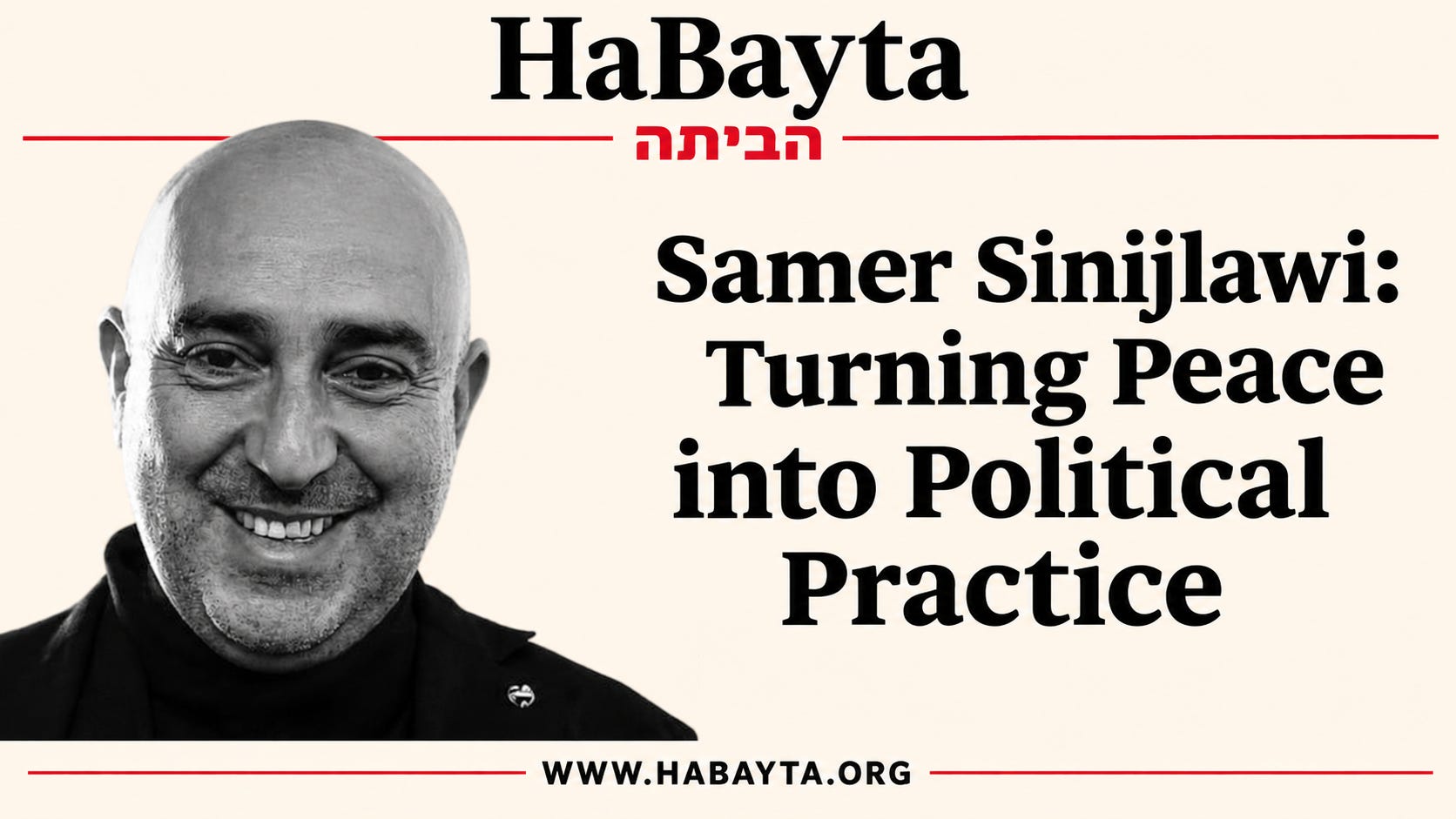
In Hebron, Samer Sinijlawi, with whom we maintain daily contact thanks to our mutual friend Richard Abitbol, welcomes Israeli activists, including Mor Inon, whose parents were murdered on October 7. In Jerusalem, his movement, Masar Jadid, calls for joint Israeli-Palestinian action for Gaza. Two initiatives reflecting a distinctive political strategy: turning dialogue into concrete action. Yet a fundamental challenge remains: how can the recognition he enjoys in Israel and internationally be translated into genuine political legitimacy among Palestinians?
In Hebron, Samer Sinijlawi welcomes Israeli peace activists, including Mor Inon, whose parents were murdered on October 7. In Jerusalem, his movement, Masar Jadid, is organizing a joint Israeli-Palestinian vigil calling for winter assistance to Gaza. Two initiatives raise a single question: is the Palestinian political leader attempting to establish a new way of practicing politics, beyond declarations and the divisions between communities?
Some encounters carry a significance far greater than the number of people involved.
In Hebron, in recent days, Samer Sinijlawi, chairman of the Palestinian movement Masar Jadid — New Path — welcomed Israeli peace activists, diplomats and journalists. Together, they visited several neighborhoods of the city, including Farsh al-Hawa, al-Jaladeh and Ein Deir Baha.
In a statement published on November 9, Sinijlawi explained that he wanted his visitors to witness the consequences of Israeli military operations, restrictions on movement and the difficulties faced by Palestinian families.
But what is particularly striking lies elsewhere.
Among the visitors was Mor Inon. Both her parents were murdered on October 7, 2023. Yet she remains committed to the possibility of peace between Israelis and Palestinians.
Sinijlawi describes how much their meeting meant to him. Together, they discussed the future they would wish for their children.
This encounter, in itself, resolves nothing. It does not erase the October 7 massacre, the war, political responsibilities or Israel’s security requirements. But it constitutes a political fact: an Israeli woman directly affected by Hamas terrorism and a Palestinian political leader choose to meet publicly and speak about a shared future.
Politics Beginning with Everyday Life
A few days after this visit, Masar Jadid announced another initiative.
On Friday, November 13, from 10:30 to 11:00 a.m., the movement is calling on Palestinian and Israeli activists to gather outside the U.S. Embassy’s Agron compound in Jerusalem.
The stated objective is specific: to urge Donald Trump and his administration to act to facilitate the delivery of prefabricated shelters, blankets, warm clothing and other essential supplies into Gaza ahead of winter, following damage caused by a recent storm.
This time, the issue is not negotiating the borders of a future Palestinian state or issuing yet another diplomatic statement. It is about calling for concrete humanitarian action.
These two initiatives offer a clearer understanding of Sinijlawi’s approach.
In Hebron, he seeks to establish dialogue with Israelis about Palestinian living conditions. In Jerusalem, he proposes that Palestinians and Israelis jointly present a demand to the United States.
Dialogue thus becomes an instrument of action rather than merely a declared objective.
A Different Understanding of the Palestinian National Interest
This approach is not improvised.
For several months, Sinijlawi has advocated a conception of Palestinian politics that departs from the logic of permanent confrontation.
His reasoning rests on a proposition rarely expressed so explicitly by a Palestinian political leader: Israel’s security must be taken into account in any Palestinian national strategy, not as a concession to Israelis, but because it is also part of the Palestinians’ own interest.
He also advocates a future Palestinian state founded on four principles: democracy, development, deradicalization and demilitarization.
This approach deserves serious examination.
It implies that Palestinian independence would not merely be a demand addressed to the international community. It would also have to involve a transformation of institutions, political practices and attitudes toward violence.
This is a considerable ambition. The question remains how it can be translated into reality in a deeply divided society and amid a conflict in which trust between the two peoples has been devastated.
The Question of Legitimacy
It would nevertheless be unwise to confuse Samer Sinijlawi’s international visibility with his electoral base.
His movement, Masar Jadid, is relatively new. Its ability to mobilize support and its standing within Palestinian public opinion remain to be established.
Opinion surveys describe a population deeply dissatisfied with its leaders, but such dissatisfaction does not automatically translate into support for new reformist political movements.
This is where the initiatives in Hebron and Jerusalem acquire another dimension.
Sinijlawi appears to be seeking political credibility through tangible results, relationships with Israeli interlocutors and proposals addressing the everyday lives of Palestinians.
Yet this strategy raises a fundamental difficulty.
The relationships he maintains with Israelis, diplomats and international figures may create opportunities for action. They may also arouse suspicion among parts of Palestinian society, particularly in the present circumstances.
How can external recognition be transformed into domestic legitimacy?
How can Palestinians be persuaded that a policy of dialogue can improve their lives without requiring them to abandon their national aspirations?
And how can Israelis be convinced that such a policy rests on more than the personal convictions of one man and could one day be adopted by a Palestinian leadership exercising genuine authority?
These questions remain unanswered.
An Alternative Cannot Be Decreed
The Palestinian electoral timetable has itself encountered new obstacles. Sinijlawi has denounced the postponement of the vote and the barriers facing emerging political movements. He has also accused Palestinian security services of exerting pressure on several officials within his movement.
These allegations require verification. They nevertheless highlight an essential difficulty: calling for elections is not enough to guarantee genuine democratic competition.
Political parties must also be free to organize, present their programs, campaign and reach voters.
But another, more fundamentally political question arises: can an alternative to Hamas and the traditional Fatah establishment be built without waiting for those two forces to make room for it?
Perhaps this is precisely what Sinijlawi is attempting to test.
Rather than waiting to hold power before establishing relationships with Israelis, he begins building those relationships now.
Rather than waiting for a peace agreement before addressing everyday difficulties, he attempts to secure tangible improvements.
Rather than presenting coexistence as the distant reward of successful negotiations, he treats it as a political practice to be tested today.
This approach should not be idealized. The announced initiatives do not yet allow their results to be measured. And politics cannot be reduced to symbolic encounters or humanitarian gatherings.
Masar Jadid will have to be judged by its actions, its platform, its democratic practices, its ability to persuade Palestinians and the results it actually achieves.
But it would be equally reductive to dismiss these efforts simply because they do not immediately alter the balance of power.
For years, the question of whether a Palestinian partner exists has repeatedly surfaced in Israeli political debate. It is often presented as a prerequisite for any political progress.
Samer Sinijlawi proposes, in his own way, to reverse that perspective: to begin working with Israelis in an attempt to gradually create the conditions for a political partnership.
This is not yet an answer to the question of peace.
It is a political hypothesis being tested against reality.
And that is precisely why it deserves to be followed.